
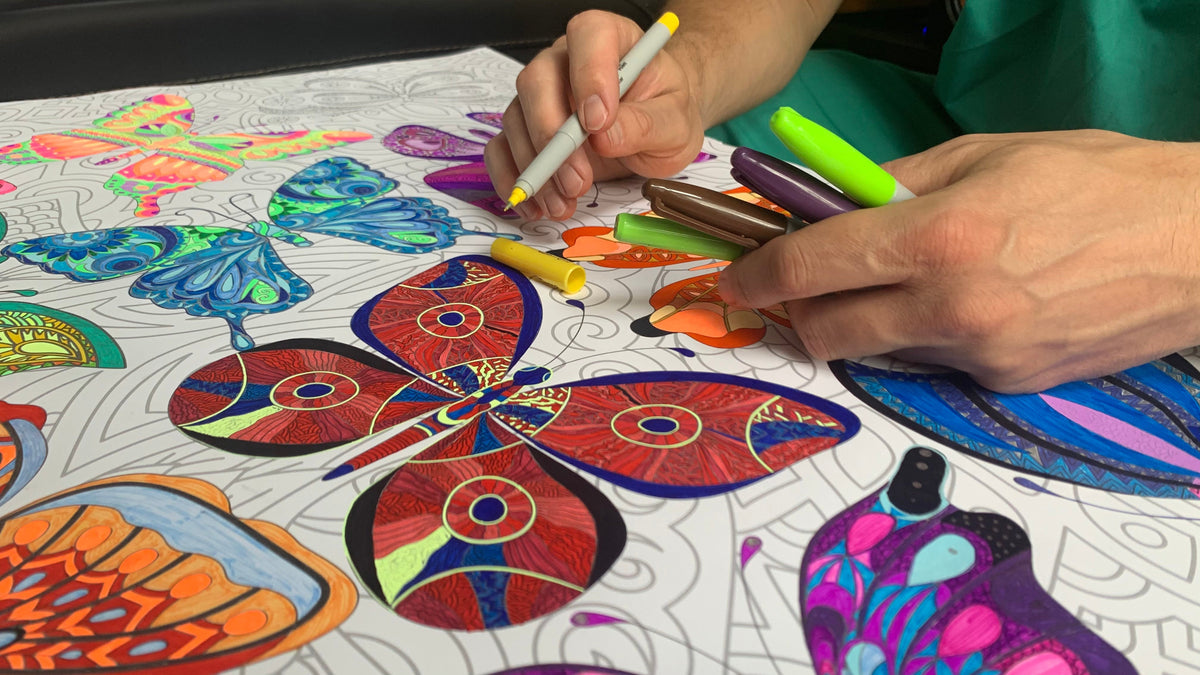
Sensory activities for adults lists tend to repeat the same handful of options: fidget tools, weighted blankets, noise-canceling headphones, stress balls. Coloring rarely makes the list — even though occupational therapists use it with adult clients for exactly the same reasons it shows up on kids' OT plans: it's a structured task that hits grip, visual-motor coordination, proprioceptive regulation, and executive function at the same time.
This post covers what coloring actually does for an adult nervous system, where adults with autism and ADHD actually use it (workplaces, day programs, caregiving settings), how the giant-poster format changes the activity for group settings, and what tools work best. A note before anything else: every adult has a different sensory profile. This is general information, not a substitute for guidance from an occupational therapist familiar with your specific needs.
Why Coloring Is an OT Activity for Adults, Not Just a Craft
Occupational therapists don't age out of using coloring once a client turns 18 — the same mechanics that make it useful for kids apply to an adult nervous system too. When someone picks up a marker and colors inside a shape, they are:
- Forming and maintaining a grip (fine motor)
- Watching where the marker goes and adjusting movement in response (visual-motor coordination)
- Feeling the pressure of the marker against the paper and regulating it (proprioception)
- Using one hand to hold the paper while the other colors (bilateral coordination)
- Starting a task, staying with it, and finishing it (executive function)
None of that is age-specific. It's the same reason occupational therapists use coloring, drawing, and other structured hand tasks with adult clients recovering fine motor function, managing sensory regulation, or working on executive function — it just doesn't get talked about as often outside pediatric OT content.
What Coloring Develops for Adults with Autism and ADHD
Fine motor control and grip. Sustained, repetitive hand use — the same motion coloring requires — is a standard component of OT plans for adults working on hand strength and precision, whether the underlying goal is sensory, motor, or both.
Visual-motor integration. Coloring inside a shape requires the hand to follow what the eyes are seeing, continuously, for the length of the session. That coordination between visual input and motor output doesn't stop being relevant in adulthood.
Proprioceptive regulation. Proprioception — the body's sense of pressure, position, and movement — is often the specific sensory channel adults with autism or ADHD are working to regulate. Pressing a marker against paper sends direct proprioceptive feedback up the hand and wrist. Varying that pressure deliberately (coloring one section lightly, another firmly) is a real force-modulation exercise, not a metaphor for one.
Bilateral coordination. One hand stabilizes the paper or poster while the other colors. Using both hands for different jobs at once is a skill some adults with autism continue working on well past childhood.
Executive function. Task initiation, sustained attention, and knowing when a task is done are executive function skills — and they're exactly what a lot of adult ADHD support work targets directly. A coloring task with a visible endpoint gives a low-stakes way to practice starting, sustaining, and finishing something.
Where Adults Actually Use This
This isn't theoretical. Giant coloring posters show up in adult settings for practical reasons, not novelty:
- Adult day programs. Programs serving autistic adults need group activities that don't require verbal participation or fine-tuned social timing. A shared poster gives everyone in the room something to do at their own pace, side by side, without forcing conversation.
- Group homes and residential care settings. Staff running a shared activity for adults with a wide range of ability levels need something that works for everyone in the room at once — a giant poster accommodates a resident who colors in broad strokes and one who works on fine detail, on the same piece.
- Workplaces and neurodivergent-friendly break spaces. Some employers setting up sensory-friendly break rooms include a standing coloring station for exactly this reason: it's a self-directed regulation tool that doesn't require explanation or supervision to use.
- Caregivers of autistic adults. A shared activity that doesn't depend on verbal exchange gives a parent, sibling, or care partner a way to spend structured time together without the pressure of conversation carrying the whole interaction.
None of these are places you'll find covered in a generic "sensory activities for adults" list built around fidget toys and weighted blankets — which is exactly the gap a giant coloring poster fills.
Why Giant Coloring Posters Work for Adult Group Sessions
Standard 8.5×11 coloring pages create a problem in group settings: everyone works alone on their own paper. There's no shared outcome, and the social element disappears. A giant poster — 24"×36" or 30"×42" — changes that:
- No competition for space. Each participant works their own section. There's no right or wrong area, and coloring outside a line doesn't affect anyone else's part.
- Accommodates different motor skill levels in the same session. One participant can work a large open area; another can work fine detail. Both are contributing to the same result.
- Shared outcome, no individual performance pressure. The finished poster belongs to the group. No one section gets singled out — which matters for adults who find individual performance or being watched stressful.
- Proximity without forced interaction. Participants work near each other around a shared surface without needing to make eye contact or take conversational turns. Proximity is built in; forced social interaction isn't.
- A visible, lasting result. A finished poster goes on the wall. That's a concrete outcome a stack of finished worksheets doesn't provide.
Coloring and Adult ADHD: Why It Works Differently Than for Kids
For adults with ADHD, the coloring task targets the same two things it does for kids — sustained attention and task completion — but the context is different: a work break, a transition between meetings, a wind-down at the end of a shift, rather than a classroom transition.
Coloring is self-pacing with a visible endpoint — you can see how much is done and how much is left, which is a different kind of task than most adult ADHD struggles with open-ended or ambiguous stopping points. The proprioceptive feedback from pressing a marker against paper is also regulating for a lot of adults with ADHD, in the same way fidgeting or pacing is, except it leaves something behind when it's done.
The giant-poster format matters here specifically because scale sustains engagement. A small coloring page gets finished, or abandoned, quickly. A 30×42 inch poster gives an adult who struggles with follow-through a task that's still there to come back to.
What Markers and Tools Work Best — and What to Avoid
Tool choice matters more here than in a casual coloring session. Get it wrong and the activity stops before it starts.
Brush pens: the best option for most adults. The flexible tip responds to light pressure, so someone with a weaker or less precise grip can still produce bold, satisfying color coverage without forcing the tool.
Colored pencils: good for deliberate force-modulation work. Pencils require intentional pressure to get saturation, which makes them useful for practicing pressing lighter or harder on purpose. They're also erasable, which removes the perfectionism trigger for anyone who gets frustrated by mistakes.
Broad-tipped washable markers: good for covering large areas quickly without hand fatigue.
Avoid cheap alcohol-based markers. The strong smell is a real sensory trigger for adults with smell sensitivity, and they bleed through paper — which can derail a session for anyone bothered by unexpected changes to their work.
Building This Into a Regulation Routine
Whether this is self-directed or set up by a caregiver or program staff, a few things make it work better:
- Set a time goal, not a completion goal. "Ten minutes with the poster" is a cleaner target than "finish this section" — it builds sustained engagement without a perfectionism trap.
- Practice force modulation on purpose. Color one area as lightly as possible, another as firmly as possible. It's a real proprioceptive exercise, not busywork.
- Keep tools consistent. Introduce one new marker or pencil at a time rather than a full new set at once.
- End on a positive note, before frustration sets in. Finishing a session before it turns into a struggle builds a positive association with coming back to it.
Choosing a Giant Coloring Poster for Adult Sensory Use
A few things matter specifically for this use case:
- Paper weight. Thick paper handles markers and brush pens without bleed-through. Thin paper tears and bleeds, which can derail a session for anyone sensitive to unexpected changes.
- Design complexity. Simple, bold designs with large open sections work well for lower-precision fine motor work. More detailed designs suit someone working on precision.
- Size. For group sessions of 4–6 adults, 24"×36" is workable. For larger groups, 30"×42" gives everyone room to spread out.
Giant coloring posters by SJPrinter ship on heavy paper stock and come in designs ranging from open botanical patterns to detailed themes. All ship same business day from Cherry Hill, NJ — daily UPS pickups, orders out within hours. Orders shipped outside New Jersey have zero sales tax. South Jersey families, programs, and therapy practices can pick up at 1400 Haddonfield-Berlin Road, Cherry Hill, NJ 08003.
For a related angle on adult coloring: Coloring for Adults and Seniors.
This Works for Kids Too
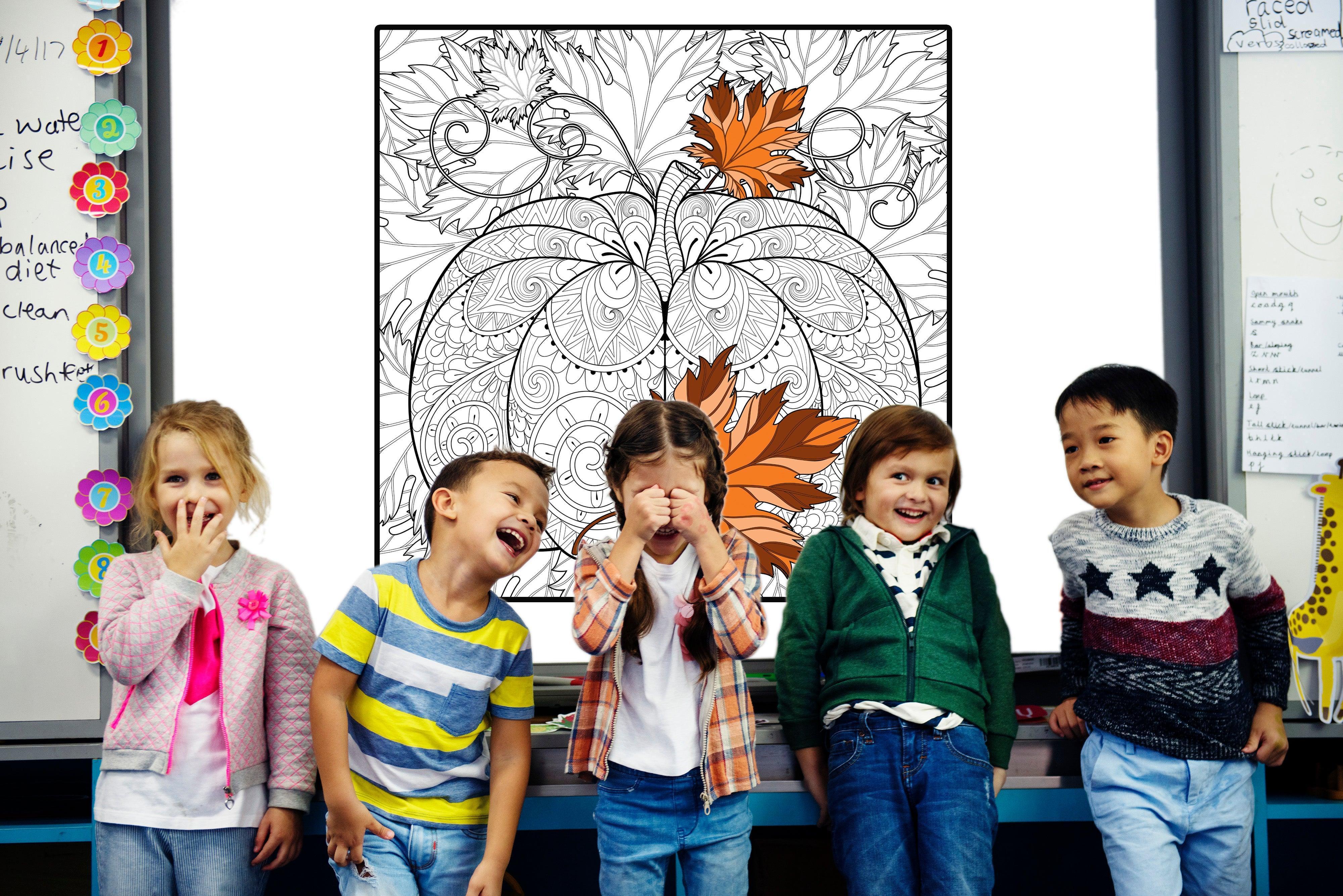
Everything above applies to children with autism and ADHD as well — coloring is on OT treatment plans for kids for the same underlying reasons. Autism Speaks lists coloring alongside writing and cutting with scissors as one of the fine motor skills occupational therapy addresses for children with autism. The giant-poster format works the same way for a group of kids as it does for a group of adults: no competition for space, no individual performance pressure, and a shared result at the end. If your child sees an occupational therapist, ask them whether a coloring routine — home or clinic — fits their specific goals.
Frequently Asked Questions — Sensory Activities for Adults with Autism and ADHD
Is coloring a real sensory activity for adults, or just something for kids?
It's used with adult clients in occupational therapy for the same reasons it's used with kids — grip, visual-motor coordination, proprioceptive regulation, and executive function don't stop being relevant after childhood.
What does coloring actually develop for an adult with autism or ADHD?
Fine motor control, visual-motor integration, proprioceptive regulation (sensing and controlling pressure), bilateral coordination, and executive function skills like task initiation and completion.
Why does coloring work differently for adult ADHD than it does for kids?
The mechanism is the same — a self-pacing task with a visible endpoint that supports sustained attention — but the context is different: work breaks, meeting transitions, and end-of-shift wind-down instead of classroom transitions.
Why are giant coloring posters better than regular pages for adult group sessions?
Multiple people work the same surface without competing for space or being singled out for their section. Different skill levels are accommodated on the same poster. The finished result is a shared, visible outcome instead of a stack of individual pages.
What markers work best for sensory-sensitive adults?
Brush pens for most people — responsive to light pressure. Colored pencils for deliberate force-modulation practice. Avoid cheap alcohol-based markers: the smell is a real trigger for smell-sensitive adults, and they bleed through paper.
Does this work for kids too?
Yes — the same mechanics apply. See the section above.
Related Posts
→ Coloring Activities for Seniors with Dementia: What Works and Why
→ Group Therapy Activities for Adults: The Hands-On Option Most Lists Skip
→ Coloring for Adults and Seniors
→ The Homeschool Art Activity That Keeps Every Kid Busy While You Actually Teach
Giant Coloring Posters for Adult Sensory Programs and Home Use
SJPrinter giant coloring posters ship on heavy paper stock — same business day from Cherry Hill, NJ. Multiple sizes and designs. Zero sales tax outside New Jersey. Local pickup available for South Jersey families and therapy practices.
856-429-0715 | info@sjprinter.com | 1400 Haddonfield-Berlin Rd, Cherry Hill, NJ 08003
Leave a comment
All comments are moderated before being published.
This site is protected by hCaptcha and the hCaptcha Privacy Policy and Terms of Service apply.